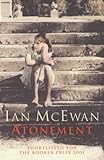
 Once reading one of the stories by Jorge Luis Borges I came across the idea that Jesus Christ was not the son of God, in reality the son of God was Judas, as his suffering was uncomparably more terrible. Jesus went through real physical torture and was crucified but he knew he would resurrect and be loved and worshiped through centuries, while Judas chose to be damned, hated, never forgiven... For what? Ten silver coins? Whose torture was worse? Hell is inside...
Poor, poor Briony, - all I could say while reading the book. I could not hate her, I could not stay indifferent. On the contrary, with every page I turned I felt that suffocating pity for her as I realized her atonement is impossible to find. The hell was hers.
The book consists of four parts. In the first and most detailed one, we see 13-year old Briony commit her crime that will lead to terrible consequences for her sister Cecilia, Robbie Turner and Briony herself. In the second part, after three years spent in prison Robbie is in surrendering France of 1940 during Dunkirk evacuation with every horror of the war and his ruined life described. The third part is devoted to already 18-year old Briony who works as a nurse in the hospital. And finally the fourth part brings us in the year 1999 with Briony, a successful novelist in her 70s. Is the atonement found? She is to answer.
We all make mistakes. Some of us are lucky that these mistakes do not cause tradgedies. Or maybe they cause and we simply do not know about them, or we prefer not to know. At the same time, how many of us long for atonement, how often we hurt with words or deeds. Who am I to judge Briony? Or to hate her? All I can say is - poor, poor Briony...
I am amazed by the talent of Ian McEwan, his ability to detail everything and create such tension that sometimes I feel like I cannot go on reading (I am unable to not read through my heart), that is why most of his books are likely to appear in my blog one of these days.
The Madonnas of Leningrad by Debra Dean
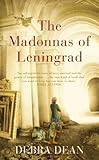 The truth is I have picked up the book because of the title (which quite often happens). The topic of the Second World War has always been of a particular interest to me. Besides those never-ending stories questioning the genuineness of the Hermitage masterpieces and everything written and filmed about the 900-day Siege of Leningrad only aroused my interest.
The book consists of four parts. In the first and most detailed one, we see 13-year old Briony commit her crime that will lead to terrible consequences for her sister Cecilia, Robbie Turner and Briony herself. In the second part, after three years spent in prison Robbie is in surrendering France of 1940 during Dunkirk evacuation with every horror of the war and his ruined life described. The third part is devoted to already 18-year old Briony who works as a nurse in the hospital. And finally the fourth part brings us in the year 1999 with Briony, a successful novelist in her 70s. Is the atonement found? She is to answer.
We all make mistakes. Some of us are lucky that these mistakes do not cause tradgedies. Or maybe they cause and we simply do not know about them, or we prefer not to know. At the same time, how many of us long for atonement, how often we hurt with words or deeds. Who am I to judge Briony? Or to hate her? All I can say is - poor, poor Briony...
I am amazed by the talent of Ian McEwan, his ability to detail everything and create such tension that sometimes I feel like I cannot go on reading (I am unable to not read through my heart), that is why most of his books are likely to appear in my blog one of these days.
The Madonnas of Leningrad by Debra Dean
The truth is I have picked up the book because of the title (which quite often happens). The topic of the Second World War has always been of a particular interest to me. Besides those never-ending stories questioning the genuineness of the Hermitage masterpieces and everything written and filmed about the 900-day Siege of Leningrad only aroused my interest.The main character of the book is Marina, a guide at the Hermitage Museum before the War. The author offers us two plot lines: the first one takes place in the Soviet Union during the Siege of Leningrad when Marina along with the others helps to evacuate priceless paintings and goes through the starvation, horror of the bombings and loss of the family members. The second plot line brings us to contemporary America where Marina, already in her eighties, resides with her husband having emigrated there by a chance right after the War. She is suffering from Alzheimer disease but somehow forgetting the names of her children and the look of her husband the only thing she manages to remember are those paintings in the Hermitage.
It is quite hard to judge a book that brings about such a topic. Out of the two lines the first one (depicting Marina's war experience) is much stronger written. However, it seems quite understandable to me how impossible it is for the second one to compete here. What I was missing is sharing Marina's knowledge (that obviously kept her alive when most needed) with her family members so that it did not seem to disappear.
Another problem I had was the language. I could not help thinking the author was either Russian or used Russian idiomatic phrases translated into English on purpose. I am not sure though that "something for the hens to laugh at" or "the future is written with a pitchfork on the water" rings a bell to non-Russian speakers. It felt like a word-for-word translation to me and there are much more of them in the book.
I think the books is worth reading, especially for those who lack the knowledge of the heroic effort of the Soviet People to survive those horrible 900 days and yet to try and rescue the city. I admit I am normally rather sceptical about any attempt from American writers or film directors to raise the question, but I am thankful to Debra Dean for doing so (it is not that hopeless in America, after all).
It is quite hard to judge a book that brings about such a topic. Out of the two lines the first one (depicting Marina's war experience) is much stronger written. However, it seems quite understandable to me how impossible it is for the second one to compete here. What I was missing is sharing Marina's knowledge (that obviously kept her alive when most needed) with her family members so that it did not seem to disappear.
Another problem I had was the language. I could not help thinking the author was either Russian or used Russian idiomatic phrases translated into English on purpose. I am not sure though that "something for the hens to laugh at" or "the future is written with a pitchfork on the water" rings a bell to non-Russian speakers. It felt like a word-for-word translation to me and there are much more of them in the book.
I think the books is worth reading, especially for those who lack the knowledge of the heroic effort of the Soviet People to survive those horrible 900 days and yet to try and rescue the city. I admit I am normally rather sceptical about any attempt from American writers or film directors to raise the question, but I am thankful to Debra Dean for doing so (it is not that hopeless in America, after all).


No comments:
Post a Comment